

The 1969 Camaro: The Car Every Dad Dreamed About
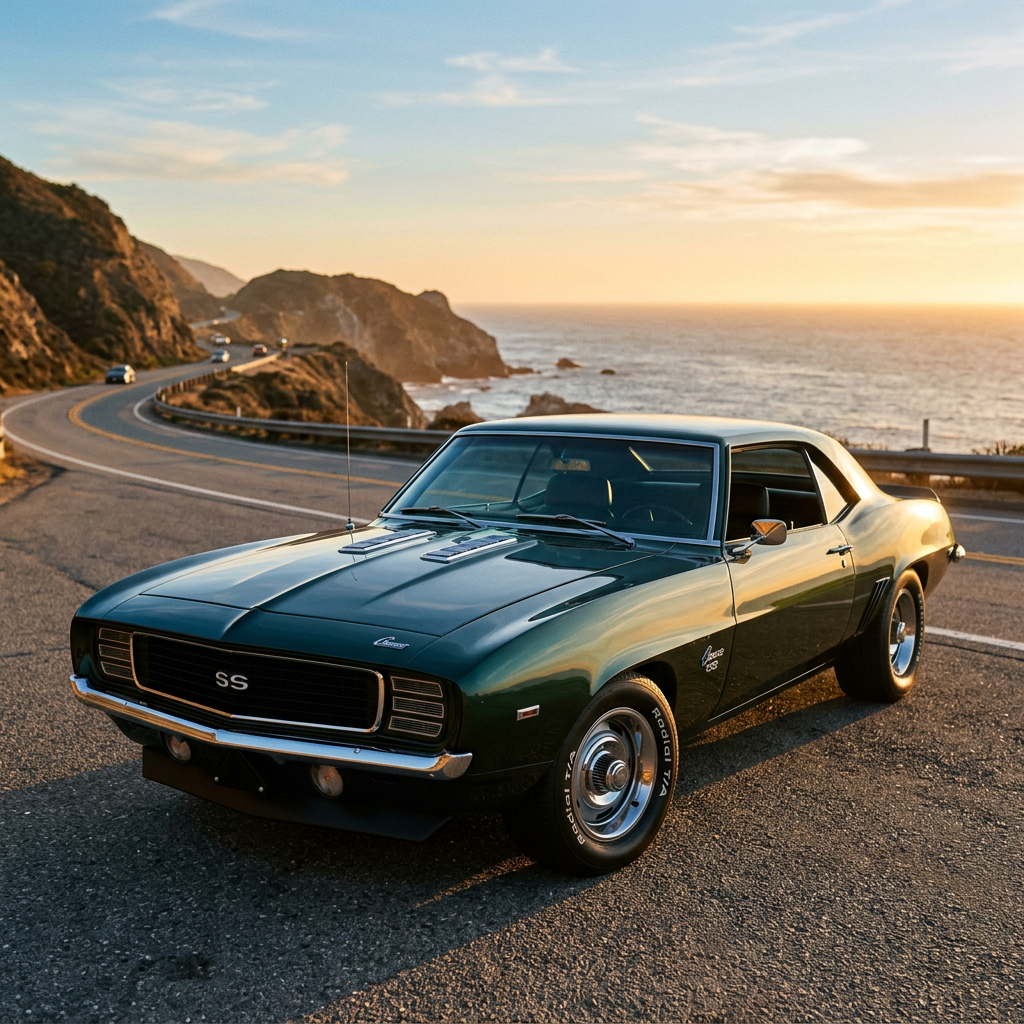
The 1969 Camaro: The Car Every Dad Dreamed About
There's a photograph your father never took — but you can still see it perfectly. A 1969 Camaro SS in Fathom Green, parked in a gravel driveway on a Saturday morning. The hood is up. There's a coffee can full of tools on the fender. And the man standing next to it isn't just a man — he's everything you ever wanted to be.
You didn't need to live through 1969 to feel it. That car carries its era the way a song carries a memory. You hear the engine note once — even on a YouTube video, even through cheap speakers — and something in you recognizes it. Something older than you.
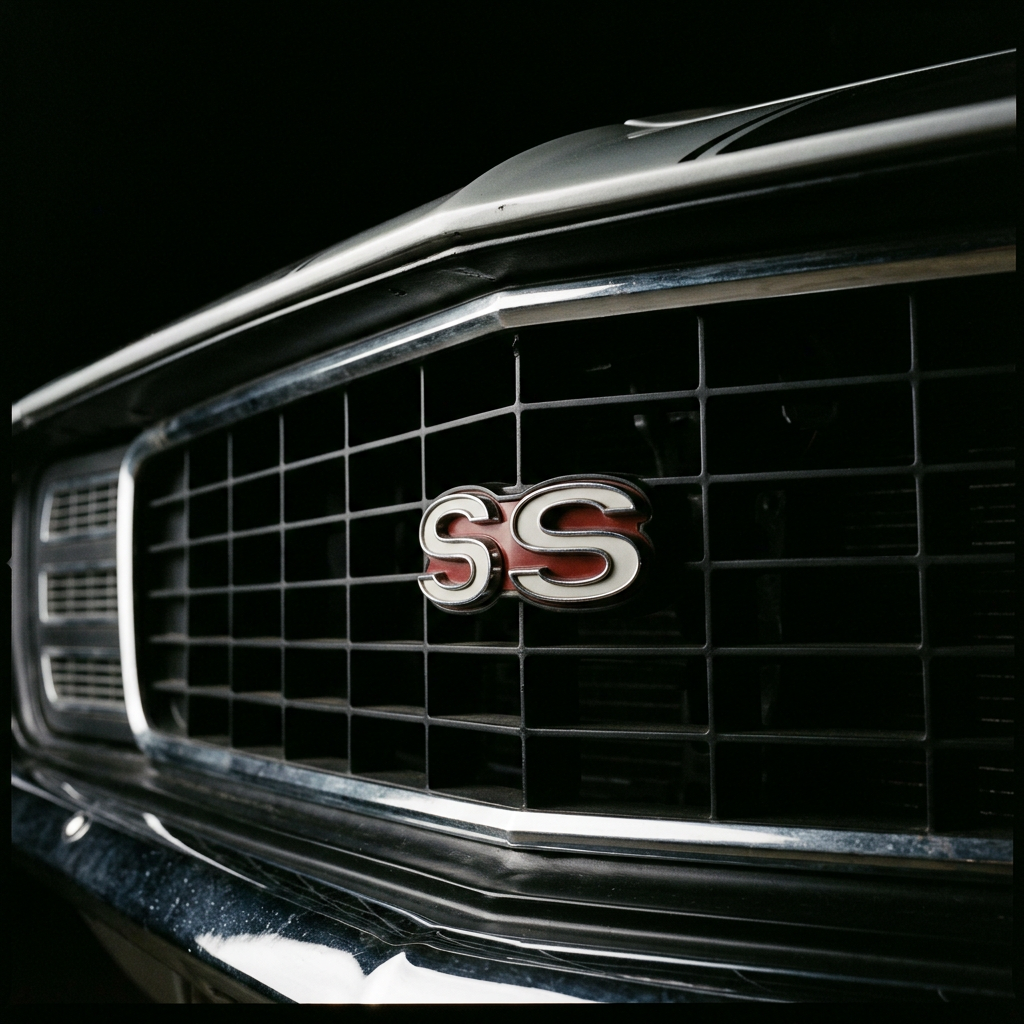
The Story Behind the 1969 Camaro
Chevrolet launched the Camaro in 1967, two years behind Ford's Mustang, playing catch-up in what would become the most passionate rivalry in American automotive history. But by 1969, Chevy wasn't catching up anymore. They had taken the lead — and they knew it.
The 1969 model year brought a complete redesign. The body grew longer, lower, wider. The roofline dropped into a fastback sweep that looked like it was moving even standing still. Chief designer Henry Haga and his team gave the car an aggression the earlier models hadn't quite achieved — a wide-mouthed front end that seemed to be holding its breath before it exhaled through twin exhausts.
It was the last year of the first-generation Camaro, and in many ways, it was the best year. Over 243,000 units rolled off the assembly line at Norwood, Ohio and Van Nuys, California — a record for the nameplate. America wanted this car. America needed this car.
What Made the 1969 Camaro Different
The numbers tell part of the story. But only part of it.
| Engine Option | Displacement | Horsepower | 0–60 mph |
|---|---|---|---|
| Base 307 V8 | 307 ci | 200 hp | 8.4 sec |
| SS 396 | 396 ci | 375 hp | 6.1 sec |
| ZL1 (aluminum 427) | 427 ci | 430 hp+ | 5.3 sec |
| COPO 9560 (iron 427) | 427 ci | 425 hp | 5.6 sec |
But the numbers don't explain the ZL1. Only 69 ZL1 Camaros were ever built — each one costing more than $7,000 at a time when a base Camaro sticker was under $2,800. The all-aluminum 427 engine was so expensive that dealers couldn't sell them. Most sat on lots for months before Chevy bought them back. Today, a ZL1 in good condition sells for over $500,000. Not because of the horsepower. Because of what it represents.
The 1969 Camaro in American Culture
The '69 Camaro wasn't just a car. It was a statement about what America believed in at a moment when America wasn't sure what it believed in anymore.
1969 was a year of contradictions. Men walked on the moon while cities burned. Woodstock happened. The Vietnam War ground on. And in the middle of all of it, a generation of young Americans went to dealerships and pointed at a car that said: I am still here. I still move. I still go fast.
The car appeared in films, in muscle car magazines, on drag strips from Pomona to Englishtown. It was raced, modified, cherished, and occasionally destroyed in ways that make collectors wince today. Steve McQueen was a Mustang man — but the Camaro belonged to the working class hero, the shop foreman, the guy who built things with his hands and drove something that matched who he was.
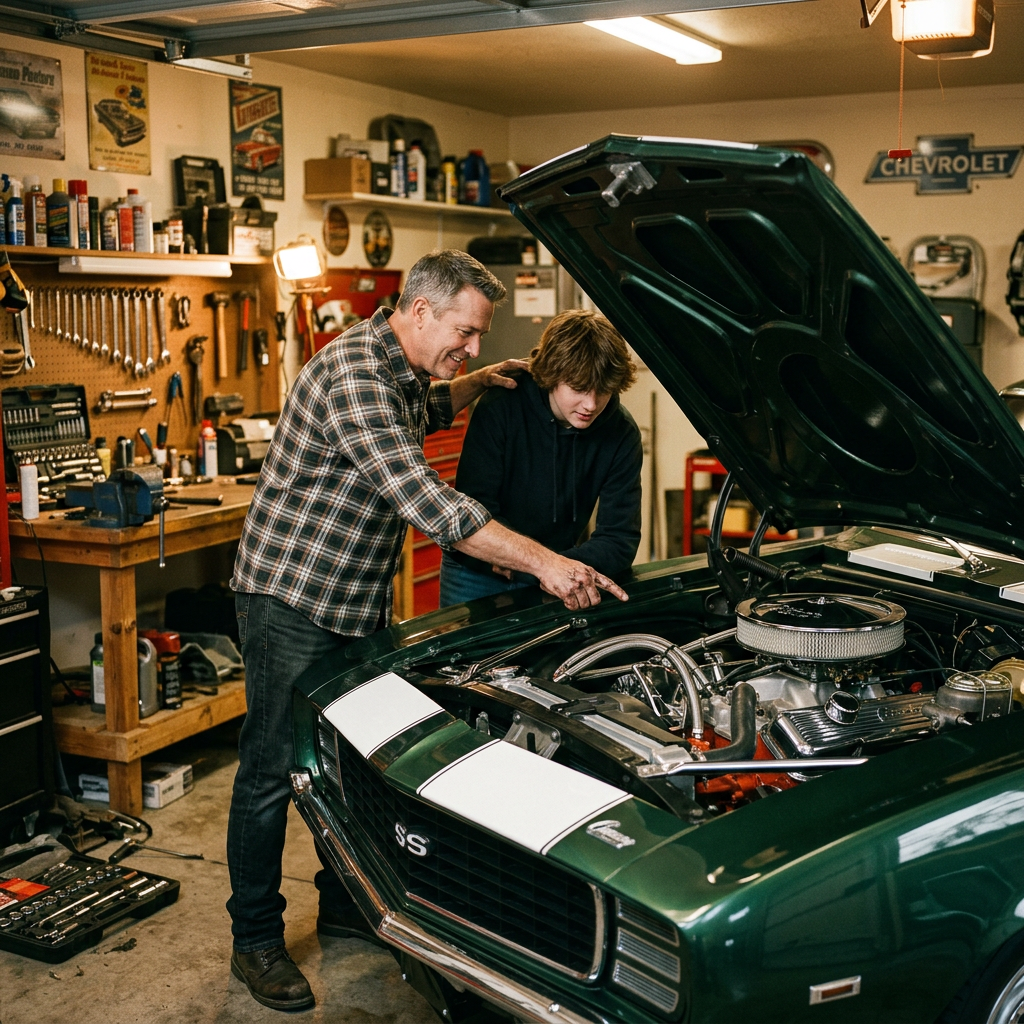
Why Collectors Still Hunt the 1969 Camaro Today
Original, numbers-matching 1969 SS Camaros regularly sell at Barrett-Jackson and Mecum auctions for $60,000 to $150,000 depending on condition and options. COPO models push well beyond that. The market has appreciated steadily for two decades — not because of speculation, but because the supply is finite and the demand is generational.
The men who grew up dreaming about this car are now at the age where they can afford to own one. And their children — raised on stories and photographs — want one too. That's not a market trend. That's a love story that keeps renewing itself.
How to Honor the Legend
Not everyone can park a '69 Camaro in their garage. But that doesn't mean you can't carry the legend with you.
For the classic car lover who lives and breathes this era, a custom metal wall sign brings that same spirit into any garage, man cave, or workshop. Handcrafted in steel, with the silhouette and soul of the cars that defined a generation — it's the kind of piece that stops visitors cold and starts conversations that last for hours.
Explore the Classic Car collection at Leaves Design — each sign is crafted for the people who don't just appreciate these cars, but feel them.
Frequently Asked Questions
Q: What makes the 1969 Camaro so special compared to other muscle cars?
A: The 1969 Camaro combined an aggressive redesigned body, a wide range of powerful engine options — including the rare ZL1 aluminum 427 — and a cultural timing that made it the symbol of American muscle at its peak. It was the final year of the first-generation design, making it a definitive endpoint for one of the most beloved eras in automotive history.
Q: How many 1969 Camaros were produced?
A: Chevrolet produced 243,085 Camaros for the 1969 model year across plants in Norwood, Ohio and Van Nuys, California. Of those, only 69 were the ultra-rare ZL1 aluminum 427 COPO Camaros — making them among the most valuable production muscle cars ever built.
Q: What is a 1969 Camaro worth today?
A: Values vary significantly by trim and condition. A base 1969 Camaro in restored condition typically sells for $30,000–$50,000. An original SS 396 in excellent condition ranges from $60,000–$150,000. Rare COPO and ZL1 models have sold for $300,000–$550,000 at major auctions.
Q: What year Camaro is the most valuable?
A: The 1969 Camaro, particularly the ZL1 and COPO variants, is consistently the most valuable first-generation Camaro. Among all generations, the 1969 model year holds the highest collector demand and auction prices due to its rare engine options, final-year status, and cultural significance.
Q: Why did Chevrolet stop making the first-generation Camaro after 1969?
A: The 1969 model year was extended due to a labor strike at GM plants, which pushed the 1970 model's introduction late into 1970 as a 1970½. The second-generation redesign represented a deliberate shift toward a more refined, European-influenced style — a response to changing market tastes and tightening emissions regulations.
Q: Is the 1969 Camaro a good investment?
A: Historically, yes. First-generation Camaros — especially SS, RS, Z/28, and COPO variants — have appreciated consistently over the past 20 years. However, experts caution that buying for emotional value first and investment second leads to better decisions. The cars that hold value best are numbers-matching originals with documented history.
Some cars are just transportation. And then there's the 1969 Camaro — a machine that somehow captured an entire generation's longing for speed, freedom, and a simpler version of the American dream. The men who built it are gone. The era that made it possible will never come back. But the car itself endures. And every time one fires up — that deep, rattling V8 idle settling into a rumble — 1969 comes back with it.